

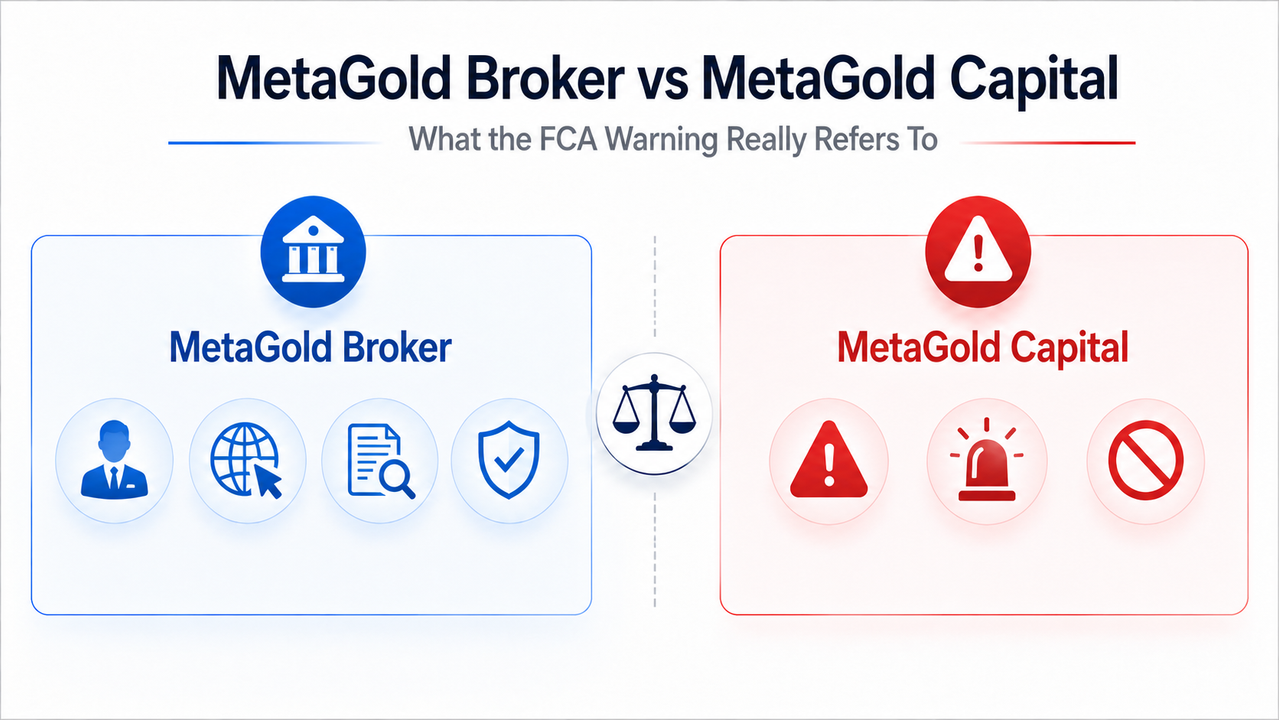
This article explains how traders should interpret FCA warnings when similar company names are involved. The focus is not on dismissing regulatory warnings, but on understanding exactly which legal entity, website domain, and company details a warning refers to.
In the case of MetaGold Broker and MetaGold Capital, name similarity may create confusion for traders who are researching broker verification online. This guide outlines why checking the exact entity matters, how to compare official records and domains, and why traders should review transparency statements before assuming that a warning for one company applies to another.
Why Are Traders Searching for a MetaGold FCA Warning?
When traders research a Forex or CFD broker, one of the first things they often check is whether the broker appears on any regulatory warning list. This is a responsible step, especially in leveraged markets where traders need to understand the exact company, website, and legal structure behind a trading brand.
Searches related to a “MetaGold FCA warning” usually come from one main question: does the warning refer to MetaGold Broker, or does it refer to another company with a similar name?
This distinction matters because regulatory warnings are tied to specific entities, names, domains, and details. A similar brand name alone is not enough to conclude that one warning applies to another company. Traders should always verify the exact legal entity before forming a judgment.
What the FCA Warning Actually Refers To
The FCA warning commonly associated with this search term refers to MetaGold Capital, based on the entity name and details shown in the warning. This is why traders should avoid relying on the shared “MetaGold” keyword alone.
A common mistake is to search for a brand keyword and assume that every similar result applies to every company using a similar name. This can create confusion, especially when two businesses operate under different legal identities, websites, jurisdictions, or ownership structures.
For traders, the correct approach is not to rely on name similarity. Instead, they should compare the full company name, website domain, registration information, and official statements before making any conclusion.
Why Legal Entity Verification Matters in Forex and CFD Trading
Forex and CFD trading involve complex products, leverage, and market risk. Because of this, traders should verify who they are dealing with before opening an account or funding it.
Legal entity verification helps traders understand which company operates the website, which jurisdiction is mentioned, what regulatory or registration information is provided, and whether the details match official records.
This process does not remove trading risk, but it helps traders avoid misunderstandings and make better-informed decisions.
Checking the Exact Company Name
The first step is to check the exact company name. A warning for one entity should not automatically be applied to another entity unless the names, domains, registration details, and other identifiers match.
For example, “MetaGold Broker” and “MetaGold Capital” may appear similar at first glance, but traders need to examine whether they refer to the same legal entity or to separate businesses. The full legal name is more important than a partial keyword match.
Reviewing the Official Website and Domain
The second step is to review the official website and domain. Domains are important because unrelated companies may use similar names, while operating through completely different websites.
A trader should check whether the domain mentioned in a warning matches the broker’s official website. If the domains are different, that does not automatically resolve the matter, but it is a key detail that must be reviewed before making assumptions.
Because similar company names can easily create confusion, traders should review the official MetaGold Broker and MetaGold Capital clarification before assuming that an FCA warning for one entity applies to another.
Comparing Regulatory and Warning-List Information
The third step is to compare regulatory and warning-list information carefully. Traders should check the regulator’s official warning page, the company name listed there, the domain mentioned, and any contact details included.
They should then compare that information with the broker’s official website, legal documents, transparency page, and registration details. If the information does not match, traders should avoid making conclusions based only on search results or social media discussions.
Reading the Broker’s Official Transparency Statement
A broker’s transparency statement can help traders understand how the company presents its legal identity, operating structure, official domain, and clarification of any possible brand confusion.
However, traders should treat transparency pages as part of their research, not as the only source of verification. A careful review should include official regulator pages, company registration data where available, legal documents, risk disclosures, and the broker’s own published statements.
How MetaGold Addresses the Confusion in Its Transparency Statement
MetaGold addresses the name similarity issue through its official transparency statement. The statement explains that MetaGold Broker, operated through fxmetagold.com, is presented as a separate entity from MetaGold Capital.
The statement also outlines MetaGold’s legal and operational framework, including references to MetaGold LLC in Georgia and METAGOLD LTD in Mwali, Union of Comoros. It also provides information about the official domain, communication channels, KYC and AML procedures, internal controls, and risk disclosure.
From a trader’s perspective, the important point is not to rely on a brand name alone. The more reliable method is to compare the exact legal entity, official domain, registration details, and regulatory references.
MetaGold’s transparency statement is intended to help traders, researchers, and online readers distinguish between similar names and avoid connecting unrelated entities without proper verification.
This type of clarification is especially important in online trading, where similar names, copied branding, or incomplete search results can easily create misunderstanding.
Conclusion: Check the Exact Entity Before Making a Judgment
The key lesson for traders is simple: an FCA warning should be read carefully and matched to the exact entity it names. A warning related to one company should not automatically be applied to another company with a similar name unless the legal details, domain, and registration information match.
For anyone researching MetaGold Broker, MetaGold Capital, or any similarly named financial brand, the best approach is to verify the exact company name, website domain, warning-list details, and official transparency information.
This process does not guarantee trading outcomes and does not remove the risks of Forex or CFD trading. However, it helps traders build a clearer view of the broker they are researching and reduces the risk of confusion caused by similar company names.
[…] Read More : MetaGold Broker vs MetaGold Capital: What the FCA Warning Really Refers To […]